Wednesday, August 10, 2011

Compost is cool

After playing around for a while with composting, we've finally got a grown up three bay hot composting system, hoorah! Last summer (and winter come to think of it) was so dry that our garden really suffered. Our gutless sandy soils just can't retain moisture or nutrients without adding heaps of organic matter and the best way to do that is with compost. It's a great way of closing the loop on our organic waste and diverting it away from landfill. As a friend pointed out it's also a good way to offset your carbon emissions since it sequesters carbon. Lastly, there are few things more satisfying than making and turning good compost...

Let me show you how I built the bays. Here's what we used:

7 pallets off the verge (best quality 'H3' preferably)
6 x 75mm wood screws
4 x 1.5m star pickets
Some sheets of tin, 3 per bay
Roofing tek screws 25mm, 5 per sheet of tin
Some wooden boards for slats (preferably wide, hard wood)
Pine timber for slats to slide into (20x20mm or 30x20mm), plus nails to attach to pallets

They're fairly easy to build, however pallets are definitely not straight when you look closely and this causes problems. Ideally you want the openings of the bays to all be the same width because this means you'll need less slats and they will all fit in any bay. Anyway, I'll get to that in a mo. Here is what they will look like:  


In a cooler, wetter climate you can probably leave the tin off to allow more ventilation, but they're good in our hot dry climate to retain moisture. First thing to do is to fit two pallets together with the back against a fence for stability. We put ours against the south facing fence to be out of the heat (compost generates its own heat and therefore doesn't need it in a warm climate) and it's a great way to use a space in the garden where you can't grow anything anyway. All pallets should be the same size and facing with planks horizontally. This allows you to bang in the star pickets and to attach screws more easily (the rear pallet in the background of the photo is oriented the other way, but I had to do this because it was slightly smaller than the other pallets). The two pallets can be screwed together with a 75mm wood screw (pre-drilled), as in the photo below. Try to ensure they are on flat ground and nicely leveled. Then fit the next side pallet in the same way. You should have a bay now and you can leave it at that or keep adding bays.

The next step is to ram a star picket in between each pallet towards the front. The trick is to adjust the pallets and star pickets so that all the bays are of equal width. Get as close as you can and then wedge small pieces of timber in between the pickets and pallets to fine tune:

Next you can attach two timber battons on each side of the pallets leaving a big enough gap for the slats. Lastly, attach the tin sheets if desired with the tek screws. We don't have a solid floor to ours, just dirt. There are pros and cons to this, you'll lose some nutrients without a slab, but worms and other beneficial beasties will be able to get into it more easily.You can also attach some wooden boards on top of the pallet ends to stop things falling down and to place your cuppa/beer on. Then cut your slats to fit with a bit of leeway. Hey presto, you have some beautiful, functional compost bays all in a row:

I think three is a good number. You have one bay composting, then you can turn it a few times and it will be ready to go. You can leave it in there and start another brew and you'll still have the spare bay for turning in to. Our bays are 1.1m square. The main cost is in the star pickets and screws. We got the tin for free from a friend and the wood for slats dirt cheap at the tip shop. I'm not sure about the legal implications of picking up pallets off the verge, but there are so many of them around I don't think they'll miss them. No-one seems to blink an eyelid when I pick them up. I like to think of them as a form of corporate sponsorship (unknown to the sponsor); thanks Cockburn Cement, you need the good PR...

Now the fun bit. We usually take a few days to gather the makings of a brew. I've been told that making hot compost is like baking a cake, you add all the ingredients at once and let it bake. We pick up as many vegie scraps as we can from the local shops (up to 0.5 cubic metres) over a few days, plus straw and manures, shredded paper, fallen leaves, etc. This seems like a lot of stuff, but most of it is free (we buy sheep poo, blood and bone and straw, but use the straw in the chook yard first).


I'm not going to give a compost lesson because really I'm no expert, but we make several layers of the following ingredients:
Vegie scraps, plus any green waste from the garden
Straw (from chooks is best)
Blood and bone and sheep poo
Shredded paper
Dry leaves
Saw dust
Worm juice
Egg cartons
Dynamic accumulators (eg comfrey, nettles)
Starter from your last brew/worm farm.


Lastly, add water (lots of it all the way through, especially if you live in hot dry Perth and you are making it in summer). You probably don't need to add worms. If you build it they will come.
Slide in the slats as you build it up and go as high as you can (we got to 1.2m last time). Then cover with something like carpet and wait for the magic to happen.

Compost is magic. You put all this waste stuff in and in go the worms, beetles, bacteria, etc and it heats up and produces beautiful, rich organic matter which will suit any plant. You can turn the compost every 3-4 days if you have the time and energy (when I first turned compost it felt great, it was like this rite of passage I was going through as a gardener).Turning will speed it up but is not essential. It should take between 3-6 weeks to make good compost.


I know what some of you are thinking: I don't have the time! Don't worry, you'll get around to it some day. It took me a while to realise that I needed to do it. Once you get the hang of it it's not that hard and you'll notice the results. Yes, you can buy compost but fresh compost is alive. How alive will it be after being put in plastic bags, on a truck for X kms, sitting in a shop for X days/weeks/months?

My dad used to make good compost. He'd pee in a bucket and pour it on. I wish he'd taught me his secret knowledge. I can't blame him though, I was probably a snotty kid who thought compost was really uncool. Now I'm older and wiser of course I know compost is very cool and an important skill. Hopefully I can pass on my knowledge to Quin, but maybe he'll be a snotty kid who thinks compost is uncool (and then realises later in life that it's not and writes about it in a blog).

We have a few other ways of composting and worm farming but these are the subjects of future posts...

Thursday, August 4, 2011

TV free for a month

I don't want to say I won but more accurately, I have negotiated with my family to put the telly away for a month to see how we go without it. We are in to this a month with/without thing. July was our month with out purchasing any plastic packaging (trying at least) with the Earth Carers. It was a challenge, and we put our purchased plastic in the dilemma bag for show and tell...so here is ours:


The plastic bag itself was the funniest story. We ordered take away on the first night and made sure to explain the challenge over the phone. We got a positive response and took our containers in to be filled, which they did, no problem, but before I could say 'and here is my calico bag' the full containers were whipped up in a plastic bag quicker than a flash! Oh well. 

Anyway about the TV free month, how did I negotiate such a thing? Well, with my partner I employed the tried and true method of nagging, off and on for the last six months. He could not argue around my sound logic. For my four year old son, I used my new plastic purchasing freedom to bribe him with a packet of Chuppa Chupps. Easy. 

Here he is helping Ads unplug.
And Ads putting it up. He didn't seem as worried as he looks in the photo.

So what have we done in our first few TV free days. Well, Quin did cry on the second day when I said we would not get the telly down for Ocotonauts but he got over it. Quincey has drawn about 80 pictures and been read to a lot. Yesterday he said he was off to daydream on the couch. How wonderful. But here is the big news, he helps me with the washing up. 'Mum wets, Quin dries'. Perfect (but I cannot hope this will last). Ads is currently installing a pelmet in the living room and I have done a newsletter for our community garden. All this for giving up images of Colin Barnett scrapping the feed in tariff, famine in East Africa and America edging towards economic collapse. Fantastic!

Thursday, July 28, 2011

Quincey's Dragon Colony Garden

Quincey loves dragons and we made a dragon garden today. We got the idea from Gardening Australia. Here are the dragons with special wings. Yes DRAGONS, not dinosaurs.


I'm very proud that Quin knows how to use worm wee. 'A little bit of worm wee and a lot of water'. He was very proud of his creation.


The features include a pond, a cave with treasure, four dragons, a crocodile and lots of succulents. The whole thing cost nix and it was great fun! As Sophie said on Gardening Australia, 'the best thing to grow is gardeners'.


Monday, July 25, 2011

Rain water harvesting year 2 results

Perth gets around 750mm of rainfall a year, although recent years have seen a sharp decline. This might sound like a lot to some people, but the pattern of rainfall is not favourable either for growing food or storing the water. Around 80% of our rainfall falls in the 3 months of winter (June-August), with some in May and September to November and virtually none between December and April (unless we're lucky enough to get a summer storm). This means Perth is heavily reliant on scheme (mains) water through our hot, dry summers with vast quantities going on lawns, swimming pools and gardens (44% of residential water is used for these purposes). Unfortunately the population is rising, people are using more water per head and the drop in rainfall has caused a crash in inflow to dams which store Perth's scheme water. Last year Perth had its dryest winter on record and only 13 gigalitres (GL=1 billion litres) flowed into dams, compared to the average of 100 GL. Dams now account for just 25-45% of Perth's water supply, down from historical levels of over 90%. This means the water utility, Watercorp (and government via taxpayers) has had to fund other ways to source water. These sources are not nearly as sustainable as dams. Desalination plants have been built to turn sea water into drinking water, which is very costly and emits vast amounts of greenhouse gases due to high power consumption. Desal accounts for 20% of Perth's water supply now, with plans for more plants. Perth is lucky enough to have large amounts of potable groundwater in aquifers and this now accounts for up to 50% of Perth's water supply (source: watercorp). It is still under debate whether these levels of extraction are sustainable in the long term and what effects it will have on the ecosystems which rely on groundwater.

One way to help the broader community is for people to install rain water tanks and grey water systems in order to be more self sufficient and therefore put less demand on our struggling infrastructure. So, two years ago we decided to install a rain water tank. It's a 14,000L poly tank, which cost us a fair wack of dough but we feel it's worth it to try to make our patch a bit more sustainable. It certainly wasn't for the money we save on our bills (ha, I worked out the payback time to be about 200 years!). Our tank is about 10m downhill from the house. This means that we have the space for it and also the slope allows us to gravity feed water in from the roof. We have 4 downpipes feeding in to 1 central pipe which is buried about 300mm underground. This then goes up the side of the tank and feeds the water in. This is what's known as a 'wet system' since there is always a certain amount of water sitting in the pipes which doesn't get to the tank until the next rain forces it through. This is opposed to the normal 'dry system', where water goes from pipes above the tank down into the tank. We went for the wet system because it usually gives you the ability to feed water from a larger roof area into your tank and to give us room to install a big tank. If you don't have a sloping block then you can bury your tank underground to get the necessary drop (but this will cost you more).

Here are some tank pics:

Our mate Ryan preparing the sand pad (we paid him!)
Compacting the pad

The tank installed with Quin doing bog laps...

A tadpole filter on the downpipe, with a removable insert containing a coarse screen and fine screen to catch debris.

Pinching the neighbour's water...
  
The tank with the following: big pipe on the left is the water inlet, then water out (with gauge), then power cords for the pump and float valve, then the overflow pipe on far right.
And here are the juicy geek numbers for you:

First of all rainfall. We have a rainfall gauge and have our own figures since May 2010 (data before from nearest BOM site- Murdoch). The following chart has 2 years of data and 2 Y axes, cumulative rainfall on the right and weekly rainfall on the left. In our first year we had a great (relatively speaking!) 757mm (blue line), but this year we've only had 511mm (pink line). Thankfully we've had some decent falls since May this year to help bump up our figures after a shocking 6 months before. When we were away over east our friends got about 60mm in the 3 weeks of our stay (a dry period for them), which was what we had had in the previous 5 months!You can see from the spikey weekly rainfall the pattern of rainfall, with most rain falling in winter and flatlining in summer.
NB: No we don't have two Decembers here in Perth! I just have Excel learning difficulties...

So how much water do we harvest and use? Well I had to laugh when I read a pamphlet from the Watercorp (the experts...) recently,the winter 'Watermark'. They are promoting rain water tanks, which is great. Unfortunately they haven't a clue how much water a tank can supply to a household. They say a 2,00L tank not plumbed in to anything can save up to 26,000L a year; and that it would save up to 59,000L a year if it was plumbed into a toilet and washing machine. The 'up to' bit probably covers their arses, but I know for a fact that these numbers are much too optimistic for Perth. Our 14,000L tank plumbed into everything (whole house, garden, etc) harvests around 65,000L a year (I know this because guess what, I have a gauge on it!). I would guess that a 2,000L tank not plumbed in would save a maximum of 10,000L a year. This is based on the assumption that you could use 400L of rainwater a week for half the year (the other half of the year the tank would be empty), which is a fair bit: say 20L a day drinking/cooking water and 4 x 9L watering cans a day for the garden (remember, there's no pump in the tank so you can't water automatically or use in the shower, etc.). Another factor to consider is that if you go 5 weeks with no rainfall (common in Perth) your tank's empty. How about the 2,000L plumbed in scenario? A toilet and washing machine use 7% of household water, which equates to 30,000L a year for a 4 person household. In 6 (wet) months that adds up to 15,000L (assuming you get enough rain every 2 weeks to fill your tank, which is doubtful), so if you add the 10,000L from scenario 1 to this you get 25,000L. This makes both the figures quoted by the Watercorp at least double what is realistic.

Anyway, enough of my Watercorp bashing rant, what about some real numbers? As a household we used an average of 830L a day in year 1 and 840 in year 2. This compares to the Perth average of 870L for a 3 person household (according to Watercorp, 2008-09 data). This means we have a lot of improvement to make to our consumption. However, I think we did quite well in year 2 for two reasons. Firstly, it was a very dry year and you'd expect that to result in much higher water use for the garden. Secondly, we are always adding more retic, which means we used less water per area of reticulated garden in year 2. One interesting fact is that our use inside is around 2-300L a day or around 30% of our total usage. I know this because this is our usage when the garden retic is off. This compares to Perth's average of 52% usage inside. This means we're comparatively good with our usage inside, but we use a lot more than most people in the garden. This is because we grow lots of veggies and have 20 fruit and nut trees to water (plus a small lawn). Personally I think this is a good use of water and it's why I ignore the state water restrictions. The restrictions state that you can only water automatically twice a week for 15 minutes on each station in summer and ban automatic watering in winter. This would mean sure death to most of our veggies through summer unless we hand watered for long periods every day (sometimes twice a day is needed to keep plants alive). We do our best to conserve water by using drip irrigation and by building up the water holding capacity of our soil with compost and soil wetter. The alternative to growing our own veggies would be to buy them, with the resulting food miles and extra water use. Market gardeners use about ten times as much water as home growers (no restrictions for them), so I just don't think it adds up for us not to grow our own.

The chart below shows our water use for year 1, split into tank (green) and scheme (red), with rainfall (blue line) to indicate the times we are harvesting water. Over the whole year we used 21% tank water. We had some teething problems with our pump in this year, so at times we had a full tank but used mainly scheme water due to the pump tripping out. Even if the pump is working we always use a bit of scheme water because the waterswitch needs a tiny bit of mains pressure before it can deliver tank water (the waterswitch switches between scheme and tank depending on the amount of water in the tank). From the end of November the tank was empty for 17 weeks until mid March when we got a huge storm which half-filled the tank (it would have filled it if I'd been well prepared and cleaned gutters and filters). The long dry spell is normal for Perth and has big implications for the size of tank to buy. For us to go 'off-grid' and be self sufficient we'd probably need a tank of 80-100,000L, which is just not feasible for a suburban block. What we have done to combat this is to get the biggest tank possible and use it as efficiently as possible. The key to this is to plumb absolutely everything in to the tank. This means that there is the least waste when it's wet (via overflow to soakwells) and the maximum turnover of tank water. It results in us running out of water more quickly in spring, but this isn't that important. The rainwater switch automatically switches to scheme water when the tank runs down.


In year 2, we actually harvested as much rainfall as year 1 despite 33% less rainfall (21% tank water as a proportion of total use again). Why is this? I think there are a few explanations. One factor is that higher rainfall will usually lead to more loss via overflow, which means that the extra rainfall is not used. Another reason is that we started year 1 with an empty tank (it was brand new), but this year we had a full tank. This means that the of the 64,640L we used in year 2 only 50,000L actually fell in year 2. Next year I might start readings in January when the tank is likely to be empty to avoid this problem. The last factor explaining the amount of rainfall used this year is that we have had a lot fewer problems with the pump, which means we are constantly using rainfall and losing less to overflow.

By the way, if you're wondering about the water quality it's great. We got a filter installed with a separate tap in our kitchen for drinking water. The guy who installed it said "Oh yes, you'll need one of these because you'll be on scheme water some of the time!" In other words tank water is better than mains water if you follow a few simple rules: try to avoid debris entering gutters by pruning overhanging branches; maintain and clean your gutters at last once a year, especially before the main rainy season (you can also install a guard to stop coarse debris falling in); install filters on your downpipes (eg leafeaters or tadpoles, and clean these regularly; install a 'first flush diverter' to divert the first rains away from the tank (it's dirty because there is more crap from your roof then); install a waterboy to pump water from the cleanest part of your tank; install a bottom draining overflow and a 'calming' rainwater inlet. I haven't actually done the last 3 points, but we're planning to do them (especially the overflow tip, great idea!). The last few tips are from a great kiwi website, Waterboy.  

Here are my top tips for installing a rainwater tank:

Install as big a tank as you can afford and have the space for.
Plumb it into absolutely everything to maximise usage and efficiency.
Hook up as large a roof catchment area as possible to the tank (we even harvest from a neighbour's carport).
Maintain/replace gutters as needed (with a good drop to use all the rain and avoid stagnant water) and clean them periodically.
Download a spreadsheet to calculate the right sized tank for your rainfall zone, water usage and roof catchment available (like this).
Poly tanks are my preference. They're cheaper and have the lowest carbon footprint (no concrete pad needed).
Put a gauge on for the geek factor.

So that's about it. I hope you appreciate this post, it took a while to write (gestation period blew out due to the Tour de France)...

Where to from here? We are now planning to install a grey water system in order to cut our summer use and keep our productive trees and decadent lawn healthy. Watch this space.

Go on, install a rainwater tank. You won't regret it and the planet will make a small sigh of relief.

Saturday, July 23, 2011

Garden Clubbers

A couple of years ago we, with five other families started this wonderful garden club. Once a month (or so) we get together at one of our homes and garden our hearts out. It works so, so well. We tackle projects you wouldn't even contemplate doing alone, or if you did it would take months. Here are our rules:
  • The host family has to be orgaized so no last minute trips to Bunnings for retic bits or manure
  • The other families try their best to be on time - start at 9am
  • We have found that its best to have two or three projects. I can't believe I'm going to write this but it tends to work out as a project for the men folk (noisy tools, heavy lifting and such) and one for the women folk (easy to drop when a baby needs a mama!)
  • We all work hard, break for morning tea, then work hard again till lunch
  • The host provides the yummyest morning tea and lunch possible (can't beat Di's pumpkin soup)
  • Then we all sit around and talk about how much we love garden club, how the food is fantastic, how the kids have grown, how we miss Emma and Ryan and Noah and who's next to host garden club.

It's ace! We had garden club today at our place. We moved a fig tree, fixed up some berry treliss and beautified an ugly bit of the garden in preparation for when we open the house for Sustainable House Day (11 September). 


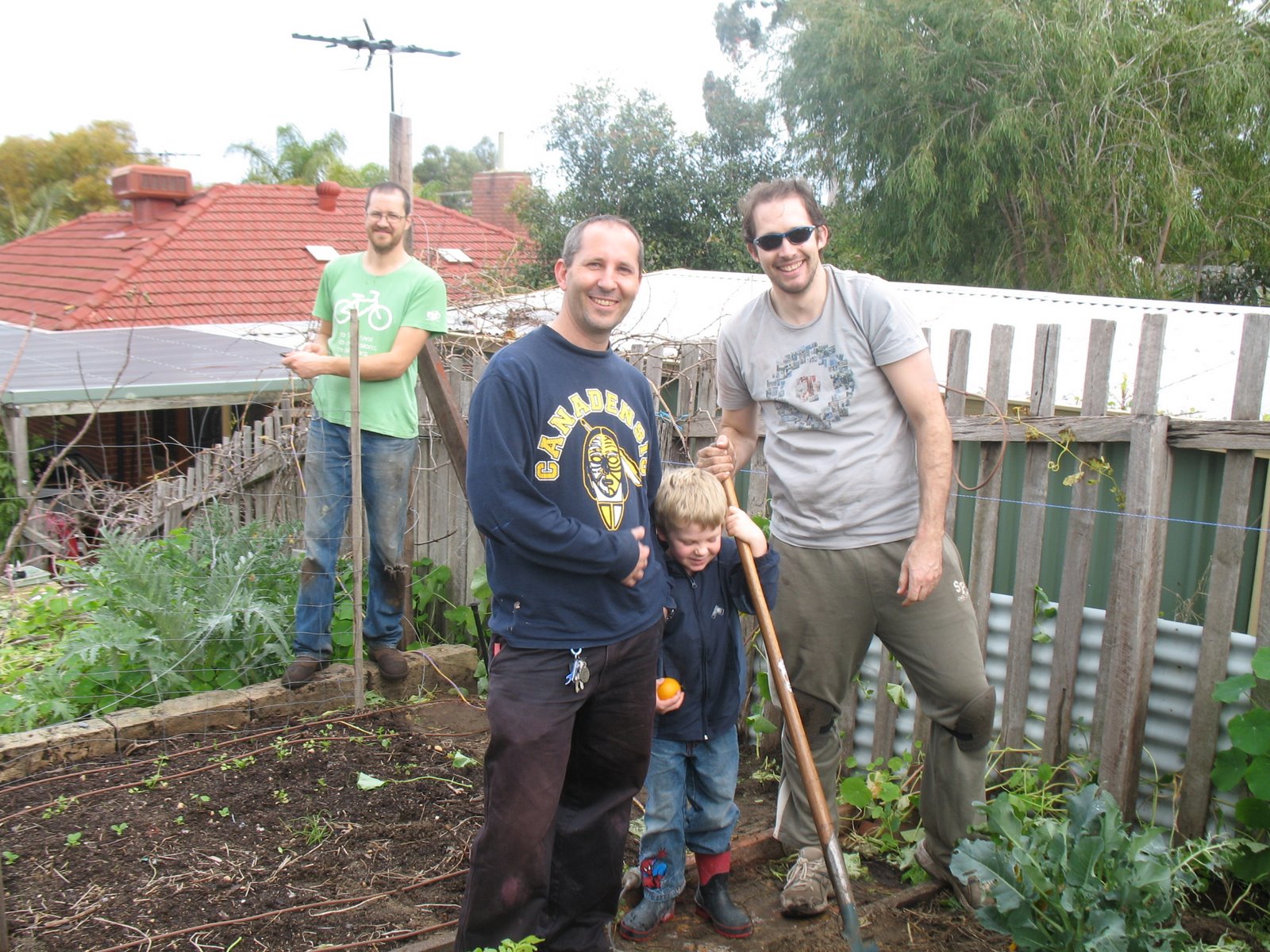
Here are the men folk fixing the treliss with lots of help (I think these guys are standing on my carrot seeds - oh well!), and here are the women folk on the weeding.

Morning tea (slice, biscuits and sourdough crackers and hummus - all home made by me! (we are on a Plastic Free July challenge, to be the subject of another post)). And yes, that is Quincey in his buzzy bee vest. He has taken it of a few times for washing. 


The kids getting grubby. It's great now that we have two little babies, two toddlers (the girls) and two older boys. They love it too.


This is one of the finished sections from today. Looks like better homes and gardens eh? I'm sure it wont look like that for long. Children and dogs will make sure of that!

Sunday, July 17, 2011

The Telly

There is chook poo on my old sneaker
The cuff of my right trouser leg is tucked in to my sock
There is grease from my chain on my shin
My thighs are thick and strong
There are greens from the garden in my belly
My belly can execute a perfect belly roll
There is a threaded needle pinned to my chest
My armpits are often smelly
  a normal me smell
There is crusted sour dough on my wrist
   and worm gunk under my finger nails
I have a pen in one hand
  and my sons sticky hand in the other
My hair is crazy and I think there is straw in it
My lips smile
My eyes are bright
My head is clear
I’ve been busy
It was truly a gift from God
  the day the telly broke.


Unfortunately, our telly is not yet broken but I may just chuck the shiz one day soon and put it in the garage. Getting rid of the telly is my not so new campaign. I have been busy though!

Thursday, June 30, 2011

Busy Buzzy Bee

It is finished! This busy buzzy bee vest has taken me about 12 months to finish with intense tutelage from my neighbour. It is the first garment I have ever knitted (not, however, the first I have started). Now finally it is finished and I am so happy it fits. Quin said he will wear it every day. He'd better!
Now I start the mammoth task of knitting Ads a vest (with beautiful op shop yarn). I can do it. I think I can I think I can...